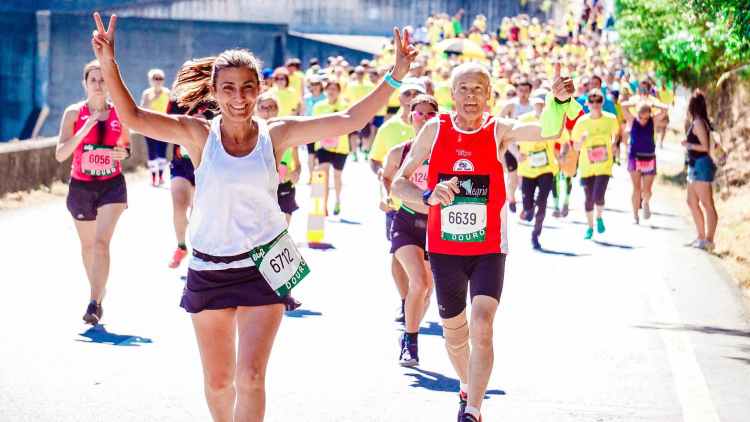
For many people, just starting out towards the goal of running a half marathon is intimidating. There is a lot of information out there regarding how to train, what to eat, what to wear. This can be very confusing and frustrating to navigate. However, amidst all the chaos and misinformation, it can be extremely beneficial to ask advice from seasoned runners to get some insight on how they prepare and recover from races.
So what is the best way towards achieving success in one’s marathon endeavors? To find out, I asked accomplished half marathon runners, Deepthi Prasanna and Laura Mcarthur—who have both competed in 15+ half marathons—to direct us on how we can follow in their footsteps and also reach our fitness goals. I also want to add that this is from their individual experience. One size does not fit all. What works for them will not necessarily work for everyone.
What would you say that you should eat as you’re training?

Laura: So I always say whatever your body likes to eat. I have a friend who eats a sweet potato, she’s gluten free. She has a sweet potato two hours before she runs with some kind of protein on it: like cottage cheese or something. I like to have a bagel with peanut butter. That seems to stick with me. But I always try to eat it two hours before I race. I just make sure I do the same thing before every long run, so my body gets used to running on the food that I’m taking in. That’s really the key. And if it doesn’t work for you, if it makes your stomach upset, try something else the next long run till you find something that works for you.
Deepthi: So the night before a long run or race I love just eating plain pasta. Literally plain pasta. Or I like to eat sweet potatoes. And then the day of, in the morning, I eat oatmeal. I don’t eat anything during the race itself, I probably may take a couple of gels depending on how I feel, but that’s about it. And then water.
In your experience what gear is the best? Is expensive gear worth the price?

Laura: If you can get something that fits you—as far as the shorts and top—and if it’s a style you like, I don’t think it matters where you buy it. If it doesn’t rub you. That’s my big thing. I make sure that all my stuff doesn’t have big seams that are going to rub on me; because I have really sensitive skin, and I’ll get a rash, and that burns when you’re running. But as far as shoes, there is a difference. And I don’t think you need to buy the most expensive ones, I always buy the last year’s model, or the year before that model. I buy the ones that are on sale. But I also know what kind of shoes work for me; I have a high arch. You have to look at your feet and maybe go to a running store and have them watch you run, take an imprint of your foot and see if you have a high arch, and tell you what type of shoes you should wear. Like neutral, supportive, or motion control, whatever based on how you run. And then stick with that type of shoe. But every brand has every type of shoe. Nike has them, Mizuno has them, Asics; they all have a high arch shoe, a motion control shoe, a stability shoe. It really just depends on what fits your foot the best. That’s what I do; I just try on a whole bunch of shoes. And if you walk around and it’s not already comfortable, then you don’t buy it. Shoes do not get more comfortable when you run in them. [Laughs] I always go up a half size. I want plenty of room in my toes so they don’t hit the top of my shoes as I’m going downhill.
Deepthi: For running, a lot of my gear is from T.J. Maxx. Because more than anything, it is really affordable there, and they have really good gear. If you wanted you could get almost the designer name-brand gear for less at T.J. Maxx. So I go to T.J. Maxx and I just buy it from there. I don’t know that gear is important. The only gear that I would say is super important is shoes. That I would not compromise on. Shoes, and for a woman a sports bra. But for anything else, anything is fine.
What do you do to train for a half marathon? What’s a typical training regimen?

Laura: If I am training for something, I try and run four days a week. I never run everyday; I always take days off. And if I feel like it, I cross train on one of those. But I make sure that I run for sure three days a week, and then I do two shorter and one longer. Like if I do two three mile runs, my third run will be a five mile. And then the next week I might go three, three, six. Or three, five, seven. You don’t want to increase too quickly, so I go up a mile or two every week, and I always make the long run a mile longer, until I get up to ten for a half. If I don’t feel like running one day I can bike, or do something else; you don’t have to run every time. But you gotta get in at least three good runs a week I think, and make one of them long.
Me: And that’s good advice. I think some people think that you just need to run, but cross-training and weightlifting can be really good to support your body.
Laura: Support your body and also prevent injuries. If you use the exact same muscle every single day, eventually you are going to wear those muscles out.
Deepthi: For a half, I usually do one speed workout during the week. I do maybe one hill run during the week, and a long run on the weekend. My long runs increase like 10% every week. So I usually follow a 16-week plan for a half, or I used to when I started. But 16 weeks is good to train for a half. If you’ve been consistently running, at least a 5k.
What are your suggestions for pre-race day prep?

Laura: You won’t sleep good the night before your race (usually). Because you have to get up early: take a bus, or whatever. You know you just don’t get enough sleep. So I make sure that two to three days before a race I get to bed early. You can’t really stock up on sleep, but you don’t want to start off in bad shape. So I try to do that. And I try to eat pasta the night before, just because that’s what they say we should do [Laughs]. I also don’t drink (I’m kind of a bad diet coke drinker); I don’t drink it 48 hours before a race. Cause they say the carbonation is bad for your oxygen or something like that.
Deepthi: Nothing new on race day or pre-race day. So whatever you do during your long training runs is what you kind of do for your race. I would say a good night’s sleep obviously is important, and make sure you don’t eat spicy foods or things like that. Just whatever you trained with in your long run, use it pre-race day. But I would say sleep is kind of most important. Because if you don’t sleep the day of the race, it could mess you up.
During a half marathon do you suggest eating or drinking anything to give you energy?

Laura: I do every other stop, and that’s how I train too. I’ll do water at the first stop, then Gatorade, and alternate stops. And if I’m training I’ll put one water and one Gatorade in my backpack and switch off. Just because I feel that you need a little bit of electrolytes if you are going to be doing something for more than one hour. It’s not a bad idea to have sugar. We used to do goo, which is so nasty. I don’t know if you’ve ever tried it.
Me: I have, yeah.
Laura: It’s so gross! So now I like those jelly beans.
Me: [Laughs] Yeah I’ve had those too.
Laura: So I keep some packs of jelly beans for if I start feeling negative. They say that when your blood sugar gets low you start to have negative thoughts, so if I start thinking, “I hate this” or “Why am I doing this this stupid race?” I think, “Ah! You must need some jelly beans!” So I throw a handful of jelly beans in my mouth. But I train that way too. Don’t take jelly beans or anything unless you’re training with it. You don’t want to do anything new for your race. So just throw some in your fanny pack or whatever and have them with you.
Me: That’s really helpful to know. I wasn’t really sure if I needed that.
Laura: You know I did marathons before they even had goo or anything. We just used Gatorade and water and we were fine. And then we started with the goo and that was fine, but it tasted so horrible. And I really like the jelly beans. Mentally it gives you a boost. You get a flavor that you really like, you’re like, “Okay!” It’s like turning on your favorite music, it just gives you a boost. I’ll say every five miles I get five jelly beans. So I’ll be looking forward to it. “Okay five-mile mark. Jelly beans!” [Laughs]
Deepthi: I will sometimes, depending on what the weather is. For an extra boost I will probably get one of the energy gels, maybe one or two during the run itself, but that’s about it.
What do you do to recover after a race?

Laura: If I’m well trained, there’s not that much recovery. I might take a day off. If it’s a big race like a marathon, I’ll bike, cause it just looses up the lactic acid. I’m not biking hard or anything. But to even just go on a stationary bike and do that for 45 minutes to loosen up your legs helps, and stretching. Working really hard like in a half marathon or a big race, I just take a day off and let my body rest. Try and get a massage after (if they do those free massages). I always do those.
Deepthi: I’ll actually have a smoothie. I’ve heard strawberries are really good for inflammation, so I have that. I will also have tart cherry juice. I would use magnesium oil if I had cramps or anything. But that’s about it. I mean right now, since I do like half iron mans as well, I have the Normatec boots which are really good for recovery. I would use that maybe after a hilly run, but otherwise nothing special really. I make sure I get a big smoothie of fruit and greens, but more than anything I get berries for inflammation.
What is your advice to stay motivated to run when you really don’t want to?

Laura: I really just let my body be in charge a little bit. If I’m really having a bad day, I take a day off. You know what I mean? But I like having goals. And so I’ll have for my week a three mile, three mile, a five mile, and a cross train; I’ll have those four things. So if I’m having a day that I’m not going to do anything I say, “Okay, but you realize that the next three days you’re going to have to do something?” But I make sure that I get those four days in. And so I just kind of say, “Okay body, you can do that if you don’t want to, but you have to make a plan for the rest of the week.” And I always make sure if I have to, I do a cross train and a run in the same day, to make sure I get ’em in. That’s how I do it.
Deepthi: I think we all go through those highs and lows where we aren’t motivated. I would say get out of the door. Put on your shoes, get out of the door, and run for ten minutes. And then if you don’t feel like running, you can give up. But you never do. Once you get out, you’ll do it. I think the key is to make it a habit, to just get up. Whatever you do, just get up. I think that’s what it is.
Me: That’s good advice. It can be really hard when you’re stressed or tired, to get up and go running, especially when it’s cold! It’s like, I don’t want to go run in the cold.
Deepthi: Yep yep. But once you get out . . . I mean I think about the highs that I feel after I finish running, you don’t get that with anything else, that feeling.
I read a lot of these books on habits, and this kind of reinforces a lot of it. Just do it, don’t miss twice. So some day you are feeling really down, you feel sick, you don’t feel good. Then don’t do it, but never miss twice, that’s my motto. Never miss twice.
Me: Never miss twice. That’s a good motto.
Deepthi: Yeah because when you miss twice, it’s very difficult to get motivated to get back in again.
After the race what do you do? Do you sign up for another race or do you take a break? How do you keep up the momentum?
Laura: I have a lot of friends who go from race to race. And I kind of do different stages. But I always try and exercise four days a week no matter what. I try to eat relatively healthy. I do like treats: so I have treats. But everything else is healthy. You know what I mean? I just made it my lifestyle—that’s just what I do.
Me: I feel like it’s hard for me because I have VERY low self control in a lot of situations. If food is there and it’s not healthy, I just want to eat it. And I feel that what you’re saying is give yourself those treats, but don’t go crazy.
Laura: Right. I have control in the morning so I start off with a super healthy breakfast; I usually have control during lunchtime, and if afternoon comes and I’m crazy hungry and eat a snack, it’s like whatever. Because I’ve had two good healthy nutrient-dense meals, so it’s okay to have a snack. And then I try to eat a healthy dinner. If I want dessert, I have dessert. You know? That’s why we exercise, so we can eat! [Laughs]
Me: That’s true. That’s true.
Laura: I had a friend whose husband was like, “You guys can’t be eating ice cream; you have a marathon in four weeks. For every pound [that you lose] you can save ten seconds off your marathon time.”
And I’m like, “Yeah we don’t care. [Laughs]
“We ran 22 miles so we could eat a big bowl of ice cream with hot fudge sauce.”
Me: [Laughing] That’s funny.
Laura: You cannot take that away from us!
Deepthi: I am always signed up for a race! [Laughs] I think the kind of person I am, if I don’t have a goal it’s very difficult to be motivated to train. So I always have my next race planned. Or at least have an idea of what the next race is going to be.
Me: So you are going from race to race.
Deepthi: Yeah. I mean I try to take a break you know in like November and December, (the holidays) even though I didn’t this past year. I jumped right in, because I am doing a 50k in April. But I try and take a break during the holidays. Otherwise, I think more than anything it’s just something to keep me motivated. And sometimes you don’t have to do like hard goals. You don’t have to sign up for another half marathon, you could sign up for a 10k or 5k. Just something to keep you motivated. Or at least that’s what I feel. Because last year I did two half iron mans, and I was a little exhausted with training for three disciplines. And then I said this year I’m mostly focused on running and getting faster, running longer, and all that stuff. So this year I have a 50k, and I’ve planned two smaller distance triathlons, but I’m not going overboard, because then you get that fatigue. You’re training for these long things and it’s just too much. You can cut yourself some slack, obviously. That’s why now I am doing shorter ones.
Me: So it’s about knowing your limits.
Deepthi: Exactly. Because I know that if I signed up for half iron mans this year too, it would have been too much mentally. Last year by the end of it I was thinking, “I’m done!” You know? [Laughs] I don’t want to be training any more! But now I’m actually really enjoying the running alone. Its what I enjoy more than anything.
Me: Yeah burnout is a big problem.
Deepthi: Oh it is, it is. So that’s why if you’re doing full marathons all the time, you could be burning out so, cut yourself some slack. And have smaller goals.
Me: What kind of small goals would you recommend?
Deepthi: If you are doing fulls then halfs; if you are doing halfs, then 10ks. Or try something different. Go try something different.
 Caitlin Runs a Half Marathon