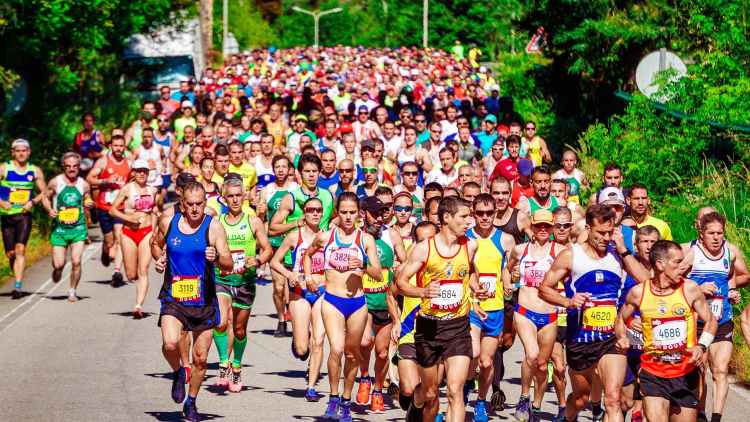
Intro to the Half Marathon
Many people have at least heard about what a half marathon is, whether they know the actual distance of the event or not. However, most people do not know the history behind the race, and how it came to be one of the most popular long distance events in recent years.
In this article I am going to guide you through the history of the half marathon, and what has led it to become so popular today. I am also going to discuss the benefits of running, specifically the benefits of running a half marathon; what training normally entails; differences between 5ks, 10ks, half marathons, and full marathons; and what makes the half marathon special.
The History of the Marathon & the Half Marathon

In order to better understand the half marathon, it is beneficial to understand the origins of the marathon. I will give a brief explanation of how the marathon came to be. If you’re a nerd like me and you love to read all the dirty details, this source gives a good explanation of the history behind the marathon.
Basically the story goes that in 490 BC in Greece, the Persian Army was trying to take over the city of Marathon; but even though they had the upper hand, they were defeated. A runner was sent to give the news to Athens, which was 25 miles away.
This relates to the modern day in that the first Olympic Games in 1896 held a 24.85 mile run as a remembrance of the battle. However it was changed to 26.2 miles in the 1908 Olympics that was held in London because the royal family wanted the race to finish right in front of them. And thus the modern-day marathon was born.
The half marathon does not have nearly as much history behind it. In the early 20th century, races similar in distance to the half marathon existed, as well as midpoint times in marathons. But the actual first half marathon races were held in 1950–1960 “to offer an alternative to the standard marathon distance” (World Athletics: Half Marathon). Though world record times in the event were not recognized by the International Association of Athletics Federations (the people in charge of international athletics and recognizing world records) until 2004. The half marathon is also not currently an event in the Summer Olympics, though the marathon is.
Why is it Beneficial?

When early humans were in hunter-gatherer societies, they traversed over long distances to hunt prey and scavenge for food. Things changed when human society shifted towards agricultural communities, and eventually the industrial revolution took place, changing the world of transportation forever. More people moved to cities to work, and new modes of transportation made travelling long distances unnecessary.
Although today we don’t need to travel long distances like our ancestors did out of necessity, long distance running has become a popular way to stay healthy, have fun, and interact with others in the past several decades.
You might think, “Why would anyone willingly run 13.1 miles?! They must be a masochist—content when they’re inflicting pain on themselves!”
Well I’m here to say that there are so many benefits to running a half marathon. These benefits include combating depression, acting as a stress reliever, developing a stronger cardiovascular system, supporting weight loss, boosting your confidence, feeling accomplished, etc.
I will go more into the why of running a half marathon in a later post.
Training

The average amount of training recommended to prepare for running a half marathon is around 12 weeks. This usually entails running or cross training (swimming, biking, lifting weights, etc.) at least four times per week.
It’s important to note that in the case of running, running more often, running for longer, or both, isn’t always better for you. Excessive running can result in overuse injuries (such as shin splints and runner’s knee) that are painful and prevent you from running. So it’s important to listen to your body and take it easy when you start feeling pain—don’t just push through it.
This is why stretching after each workout and performing strengthening exercises is vital to prevent getting hurt. This is especially true for women: many of whom have weak hips. This can lead to knee pain, as the knees have to compensate for weakness in the hips. To combat this, consistently doing hip strengthening exercises—as well as exercises that strengthen other parts of the body—along with running is the way to go in order to stay injury free!
Full vs Half Marathon: Which is Better?

How many people run half marathons compared to a full marathon? Well, ” [The] Classic marathon distance is 42.2 km [26.2 miles] with 509,000 participants [having] completed one or more of the more than 480 marathons arranged in the USA only in 2015 [18]. Furthermore, 1,986,600 completed one or more of the 2,700 organized half-marathon (21.1 km) competitions” (TJELTA, L. I., KVÅLE, P. E., & SHALFAWI, S. 2017). These statistics demonstrate that there are many more people who complete half marathons.
So why do many people opt to run a half marathon instead of a full marathon? Simple: it’s easier to train for, carries less risk of injury, and costs less. Overall, a half marathon is much less demanding than a full, at 13.1 miles to the marathon’s 26.2. However, one benefit of running a full marathon is gaining the ability to say that you did it. It’s quite an accomplishment to be able to say you completed the grueling 26.2 miles.
You might ask, “But what about shorter distances? How does the half marathon compare?” Well, the 5k (3.107 miles) and the 10k (6.214 miles) are much shorter than both the marathon and the half marathon, and are also very commonly run. They are often less expensive, and can be completed by most people who are in decent shape without training. While a lower price is always welcome, being able to complete these distances relatively easily without training does not produce the same feelings of accomplishment (for many people) as running longer distances.
The half marathon is a nice in-between event: longer than the 5k and 10k, yet shorter than a full marathon. This allows runners to feel accomplished, but not have to spend excessive energy, time, and money.
Works Cited:
TJELTA, L. I., KVÅLE, P. E., & SHALFAWI, S. (2017). The Half-Marathon Participants, Who Are They and What Motivates Them for Training and Competition? Acta Kinesiologiae Universitatis Tartuensis, 23, 42–51. 31 March 2020.
World Athletics: Half Marathon. (n.d.). Retrieved from https://www.worldathletics.org/disciplines/road-running/half-marathon. 31 March 2020.
 Caitlin Runs a Half Marathon